



Joint inflammation in horses
Joint inflammation rarely announces itself. It builds quietly, through repeated load and small mechanical stresses, long before it shows as a clear head-nod on the lunge. By the time stiffness is obvious, the joint has usually been changing for a while. Understanding how that process works — and catching it early — is one of the most useful things you can do for a horse's long-term soundness.
A healthy joint moves smoothly and under control. Cartilage protects the bone surfaces, and synovial fluid lubricates the joint and absorbs shock. When inflammation develops inside the joint, that balance shifts. Repeated strain, mechanical stress or a previous injury can trigger inflammatory activity. Over time cartilage can gradually break down, the joint capsule can thicken, and lubrication can decline. As that happens, friction increases with every stride.
Why joint inflammation develops
Joint inflammation often begins when the mechanical load on a joint exceeds what the tissue can tolerate over time. It affects sport and leisure horses alike, and it can follow overwork, repetitive strain on hard or uneven surfaces, poor hoof balance, or a previous injury that changed how the joint loads. The cause is not always dramatic. Often it is simply accumulated wear that the horse compensated for until it could no longer be hidden.
Signs of joint inflammation
The earliest changes are subtle and easily missed on their own. Taken together, these are the signs worth watching for — and comparing left to right over several days.
- A longer warm-up than usual
- Mild or subtle stiffness
- Feeling short on one rein
- Heat around a joint
- Swelling around a joint
- A change in the joint's outline
- Left–right asymmetry
- More constant stiffness as it progresses
How it progresses — the stages
Joint inflammation usually develops gradually, and the early signs are easy to miss.
Inflammatory activity increases inside the joint. There may be mild stiffness and subtle changes in performance — a horse that takes longer to warm up, feels slightly less free through a shoulder, or is marginally short on one rein. Cartilage can still look normal at this point, but the joint's function is already affected.
If the inflammation persists, cartilage quality can gradually decline. Lubrication may reduce and friction inside the joint can increase. Movement feels less supple and stiffness becomes more noticeable.
Stiffness becomes more constant and lameness more apparent. Long-standing joint inflammation can, in some cases, contribute to degenerative joint disease — often called osteoarthritis. Cartilage thins, the joint capsule thickens, and range of motion becomes more restricted. This stage affects long-term comfort and performance, which is why acting earlier matters so much.
Even small changes in movement, joint outline or symmetry are worth monitoring closely. Early evaluation improves the chances of a structured, successful approach.
What to do if you suspect joint inflammation
If something feels off, start with observation before conclusions. Note when the stiffness appears — first steps out of the stable, early in work, or only after hard going. Check for heat, swelling or a change in the joint's outline, and compare left to right. Patterns over a few days tell you more than a single moment.
Involve your vet early rather than waiting for a clear lameness. Joint inflammation responds best to a structured approach, and the earlier that begins, the more options remain open. Your vet can assess the joint properly and rule out causes that need specific intervention.
Alongside veterinary care, the day-to-day management matters. Adaptation is driven by repetition — small, consistent care often does more for a joint than occasional intensive effort.
Controlled movement rather than complete rest, in most cases.
Attention to surfaces and hoof balance.
A proper warm-up that lets the joint prepare before work.
Consistent recovery habits between sessions.
How LED treatment supports joint health
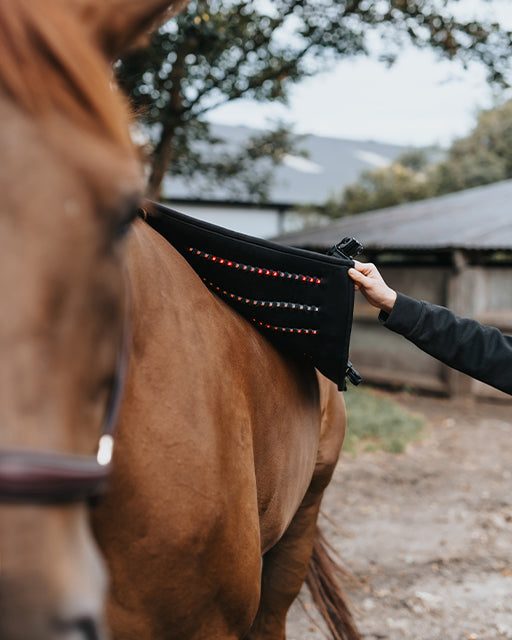
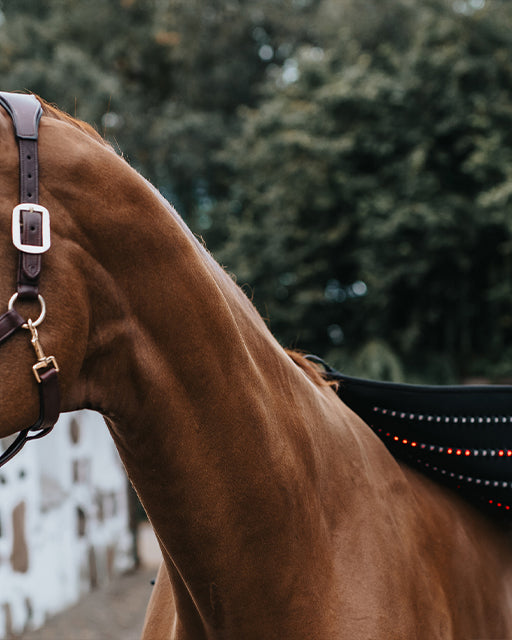
LED treatment supports the joint by working at a cellular level. Red and infrared light stimulates cellular activity and supports local circulation in the tissue around the joint — the biological processes involved in recovery and tissue maintenance. It is non-invasive, gentle enough for daily use, and designed to sit naturally within an existing care routine rather than replace veterinary treatment.
Used before work, it supports circulation and suppleness as the joint prepares to load. Used after, it supports recovery between sessions. For a horse managing ongoing joint stress, that daily consistency is where the value lies.
Chosen for their documented relevance to circulation, recovery and joint health. Each system carries two types of LED strap, alternating: red at 660/670 and 730 nm, infrared at 810 and 850 nm. No blue light. Built for daily use in real stable conditions: dust, moisture and the occasional knock.

Choosing the right system for joint work
Which system fits depends on the joint and how much coverage you need.
Wrap72
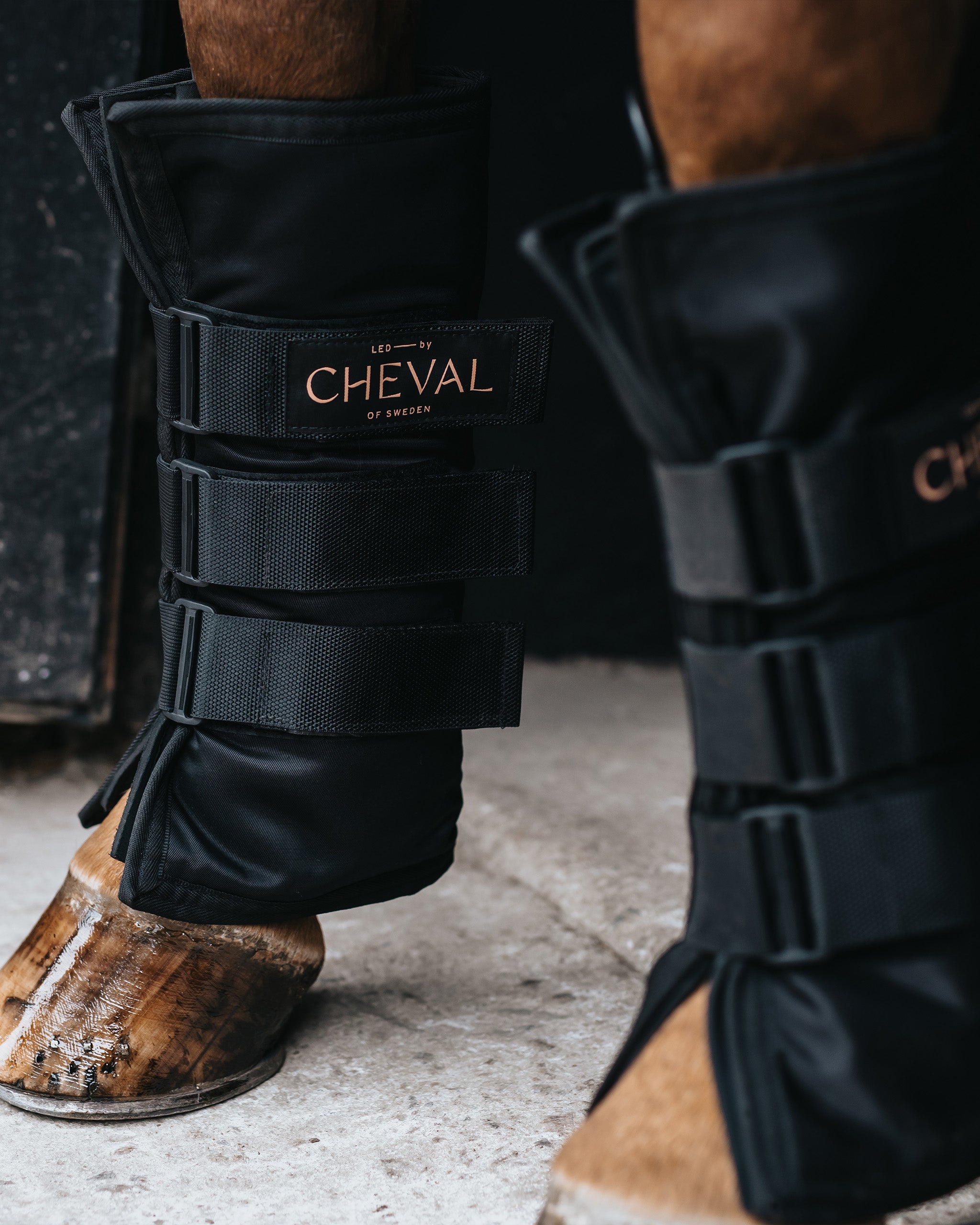
For legs and joints — fetlock, knee, hock. Suits one or two legs and targeted joint work.
Wrap108
More extensive coverage for horses that need more than one area treated, or a larger zone around the joint.
Stifle Wrap
Shaped for the stifle specifically, and adapts to the chest & shoulders and back when you need it elsewhere.
If you're unsure which fits your horse's situation, that's exactly what our system guide is for — read the guide to choosing the right system →. Still unsure? We're happy to help you decide.
You don't have to buy to begin
Our rental programme lets you start with the right system and see how it fits your horse and your routine, with no deposit, no minimum period and no binding commitment. If you decide to keep it, up to three months of rental is credited toward the purchase. Rental is available for the Wrap72, Wrap108 and Stifle Wrap.


LED treatment supports the natural processes involved in joint comfort and recovery. It is not a cure, and it does not replace veterinary diagnosis or treatment. It works best as one consistent part of a broader plan — used daily, over time, alongside good management and professional guidance.
Common questions
How do I know if my horse has joint inflammation?
Watch for patterns rather than single moments — a longer warm-up, mild stiffness early in work, shortness on one rein, or heat and swelling around a joint. Compare left to right over several days, and involve your vet early if the pattern persists.
Can joint inflammation in horses be cured?
It depends on the stage and the cause. Caught early, inflammation can often be managed well and the joint protected. Long-standing inflammation that has progressed toward degenerative change cannot be reversed, which is why early evaluation matters so much.
Should a horse with joint inflammation rest completely?
In most cases, no — controlled, consistent movement usually supports the joint better than standing still. The right balance depends on the individual case, so follow your vet's guidance.
Can LED treatment help with joint inflammation?
LED treatment supports the natural processes involved in recovery and tissue maintenance — circulation and cellular activity in the tissue around the joint. It is not a cure and does not replace veterinary care; it works best as one consistent part of a broader management plan.